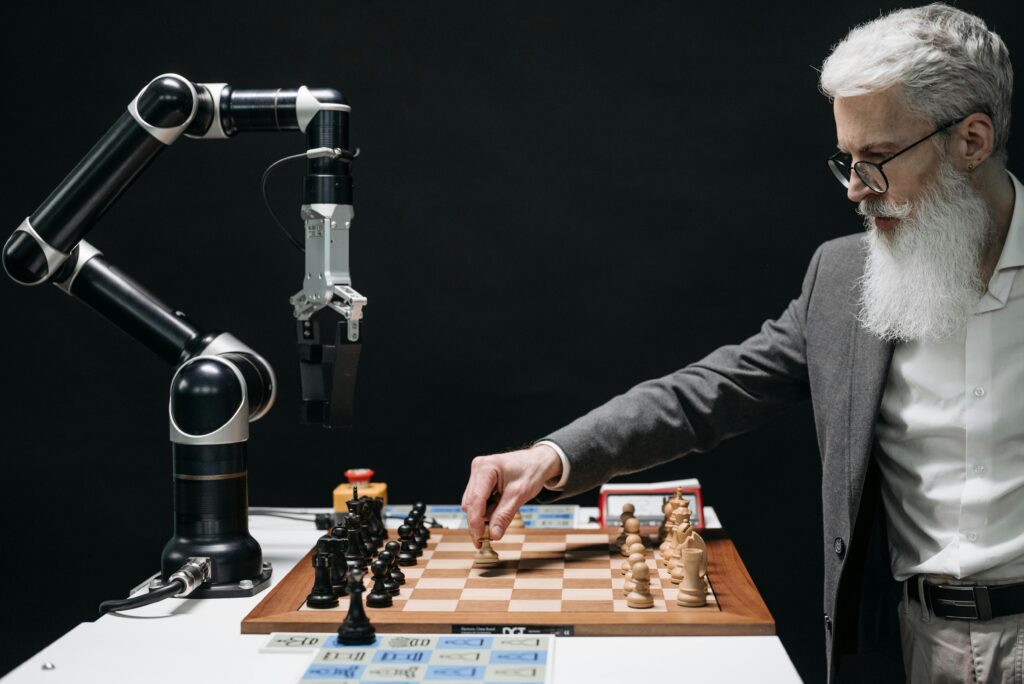
From being a future idea, artificial intelligence (AI) has quickly evolved into a major factor behind some of the biggest shifts in our contemporary civilisation. In the past ten years, artificial intelligence (AI) has transcended labs and science fiction films and has permeated every aspect of our lives, careers, education, and interactions. Because AI is so pervasive, many individuals utilise it on a daily basis without even realising it.
AI is changing many facets of daily life, whether it’s utilising facial recognition to unlock your phone, getting tailored Netflix suggestions, or interacting with a customer service bot. However, its impact goes beyond ease of use to include business, healthcare, education, and even international economies. It presents enormous opportunities, but it also poses moral dilemmas that require serious consideration.
In this article, we’ll explore the positive impacts of AI today, the challenges it creates, and what its future might mean for humanity.
Revolutionising Businesses and the Workplace
AI is driving a digital transformation in businesses across all industries. Automation is among the most significant changes. Employees can now concentrate on more strategic and creative work because AI-driven devices and software can now complete time-consuming and repetitive activities. For instance:
Customer service: AI chatbots can now handle orders, respond to inquiries, and resolve simple problems around the clock, cutting down on wait times and enhancing customer experience.
Data analysis: Businesses are employing AI to examine massive datasets that would require years of human research. Organisations can learn about market trends, consumer behaviour, and even risk avoidance with the aid of predictive analytics.
Marketing: AI algorithms that analyse customer interests and online behaviours have made it possible for businesses to target advertisements more precisely.
But the work market is also evolving as a result of this change. AI is increasing the need for new skills like AI engineering, data science, cybersecurity, and digital creativity, even as certain jobs are being automated. AI and human collaboration will probably coexist in the workplace of the future.
Advancing Healthcare and Saving Lives
Healthcare is among the most fascinating and significant applications of AI. AI is improving patient care by assisting physicians and medical researchers in making quicker, more accurate judgments.
Early disease detection: AI systems are able to interpret CT, MRI, and X-ray images with amazing accuracy; in certain cases, they can even identify diseases before human physicians do. In situations like cancer, where early identification is crucial, this could save a life.
Personalized care: AI makes medicine more efficient by assisting in the creation of customized treatment regimens based on a patient’s genetics, medical history, and lifestyle.
Drug discovery: Previously taking years, the process of creating new medications is now accelerated by AI models that can simulate and test hundreds of drug combinations in a fraction of the time.
Robotic-assisted surgery: AI-guided robots are assisting surgeons in carrying out intricate procedures with increased precision and reduced risk.
AI is in many ways improving the affordability, accessibility, and efficiency of healthcare, particularly in poor nations with a shortage of medical professionals and resources.
Transforming Education and Learning
Another industry that is drastically changing as a result of AI is education. AI technologies are making knowledge more accessible and personalized as online learning expands quickly.
Platforms for personalised learning: AI-driven applications can modify lessons to fit a student’s learning style, speed, and areas of strength and weakness. This guarantees that no student falls behind.
Virtual tutors and assistants: AI-powered chatbots and tutoring platforms are now available to students around the clock.
Breaking down language barriers: AI-powered real-time translation technologies enable people who speak different languages to access education, bridging classrooms throughout the world.
Support for instructors: AI programs can grade homework, monitor student progress, and identify problem areas, freeing up teachers’ time to concentrate on innovative instruction.
In addition to helping pupils, AI in education gives educators and educational institutions the ability to deliver more inclusive and successful instruction.
Making Daily Life Smarter and Easier
AI has been ingrained in daily life and is no longer limited to organisations and companies. Here are a few typical instances:
Smartphones: AI powers voice assistants, facial recognition, and predictive text.
Entertainment: AI is used by websites like YouTube, Netflix, and Spotify to suggest material based on user preferences.
Smart houses: Appliances like Google Home, Alexa, and smart thermostats increase the convenience and energy efficiency of homes.
Navigation: AI in ride-sharing applications and Google Maps helps us anticipate arrival times, locate quicker routes, and avoid traffic.
Although these commonplace AI applications may seem unremarkable, they mark one of the greatest advancements in human productivity and convenience.
Global Challenges and Ethical Concerns
Despite its strength, artificial intelligence has drawbacks. Among the most significant issues are:
Employment displacement: Millions of workers face job loss as monotonous duties are replaced by technology. To lessen this impact, it is essential to prepare people with digital skills.
Privacy concerns: AI systems gather enormous volumes of data, which raise questions regarding the usage and security of personal data.
Fairness and bias: AI systems may inadvertently mirror human prejudices, resulting in unjust hiring or law enforcement choices.
Deepfakes and disinformation: AI is capable of producing lifelike fake news and videos, which can be used to disseminate false information and undermine public confidence in the media.
Security and control: Some analysts caution about the potential for AI to be abused in cyberattacks or even in military settings.
One of the biggest problems of this AI-driven era is striking a balance between innovation and ethics. To guarantee AI benefits humanity, governments, tech firms, and international organisations are attempting to create ethical frameworks and rules.
Looking Ahead: The Future of AI
AI’s current effects are just the start. We can anticipate further developments in the near future, including:
Autonomous vehicles: Autonomous vehicles have the potential to lower pollution, traffic, and accidents.
Smarter cities: AI will improve transportation, trash management, and energy use, resulting in more sustainable urban areas.
Enhanced creativity: AI is assisting people in discovering new creative mediums, such as film scripts and music and artwork.
Improved climate solutions: AI can forecast natural disasters and develop long-term strategies to combat climate change by analysing environmental data.
AI has the capacity to address some of humanity’s most pressing issues if used properly.
Conclusion
Artificial intelligence is already here and is changing every facet of contemporary life; it is no longer a pipe dream. AI is opening up previously unthinkable possibilities in a variety of fields, including business, healthcare, education, and personal convenience. However, it also presents difficulties that we must face responsibly, fairly, and strategically.
The decisions we make today will have an impact on AI in the future in addition to advancements in technology. AI has the potential to make the world smarter, healthier, and more connected than it has ever been if it is created in an ethical and inclusive manner.